History and Culture A _ 2012-2013

A class blog Patricia Bou. English Studies. UV

Monday, 15 April 2013

Titanic's 101 Anniversary

On April 10th, 1912, the Titanic, the biggest and most luxurious ship ever built in history, sailed for New York, from the port of Southampton, in what was meant to be its maiden voyage. A few days later, on the early hours of April 15th, the ship went down into the Atlantic Ocean due to an iceberg collision. More than 1500 people perished in the water after its sinking, and only a few fortunates (aprox 700 people) survived thanks to the few lifeboats that the transatlantic carried.

Some of these survivors were interviewed on television in the 1970s, as it is shown in the following clip:

In 1985, over 70 years after the tragedy, the remains of the wrecked ship were found in the depths of the ocean by a French-American expedition led by Jean-Louis Michel of IFREMER and Dr Robert Ballard of the Woods Hole Oceanographic Institution. The RMS Titanic company gained full rights for the protection and preservation of the remains of the Titanic in 1994.

On its 100th anniversary, last year, Australian billionaire Clive Palmer announced that he intended to build an exact replica of the ship, named "Titanic II", that would sail, at the latest, on 2016.

[Source: Wikipedia.org]

Labels: , ,

Tuesday, 9 October 2012

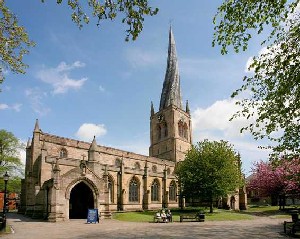
The Crooked Spire Church in Chesterfield


Its ponderous steeple, pillared in the sky
Rises with twist in pyramidal form,
And threatens danger to the timid eye
That climbs in wonder.
Samuel Bromley 1822

Although I have never actually stopped to take a picture in front of this peculiar church it is the first monument that drew my attention when I first arrived in the UK.  Soon after that I found out that there is a very interesting story behind the construction of this church and that the spire was not part of the initial design.
The construction of the church of St Mary and All Saints, the world famous Crooked Spire Church at Chesterfield, began in the late 13th Century and was finished around 1360. It is the largest church in Derbyshire and its unusual Spire stands 228 feet from the ground and leans 9 feet 5 inches from its true centre. This was not the original design of the church but only the result of an error. The Spire was ‘twisted’ when unseasoned wood was used during its construction with 32 tons of lead tiles placed on top and as the timber dried out the weight of the lead twisted the spire.


As the spire was being built at the time of the Black Death in 1349, a theory has been put forward that the original craftsmen may have died. As a result, less experienced men completed the job and they made the mistake of using green timber. There is also a lack of cross bracing in the structure.
There are of course other controversial versions of how the twist was caused and the Devil figures in the most popular version although there are several variations on this theme.
One version is that a blacksmith from the nearby village made a poor job of shoeing the Devil who, lashing out in agony as he passed over Chesterfield, gave the spire a violent kick.
Another claims the Devil was resting on the spire when a whiff of incense from below made him sneeze, and as he had his tail wrapped tightly round the spire at the time this caused it to twist.
A controversial version brings the virtue of the local ladies in to question as it says that whilst resting on the spire the Devil twisted round in surprise because the bride was a virgin.
An even more slanderous version says that the spire twisted when a virgin married in the church but will straighten when another one does.
On 22nd December, 1961 a fire broke out in the North Transept and flames swept through the building threatening the spire. It took two hours to get the blaze under control and the cost of the damage came to ₤30,000.

The Parish Church of St Mary and All Saints is a Grade I listed building and the spire is open to the public most days (except Sundays and Good Friday) and can be climbed part way up. The views from the top of the tower on a clear day stretch for miles. The spire, which is used as a symbol of Chesterfield, can often be seen from the surrounding hill poking out of a sea of mist, on a winter’s morning.  

Labels: , ,

Wednesday, 3 October 2012

Llanfairpwllgwyngyllgogerych...

There's a town in the isle of Anglesey (North Wales) whose size is inversely proportional to the length of its name:
Llanfairpwllgwyngyllgogerychwyrndrobwllllantysiliogogogoch
This town, usually known as Llanfair PG or Llanfairpwll, has the longest name place in Europe, and is the second longest name in the world, following the isle of Taumata in New Zeland.

Depite this being a rather small town, its index of population is one of the five highest in the island (According to the census of 2001, over 3,000 people) and more than the 76% of them, are fluent in Welsh. 

The peculiarity of this little town's long name has caught the attention of many tourists and curious over the years, who come to visit it and can't leave without taking a picture near a sign with the name on it, usually the one at the train station, the first one they encounter.

The translation of the name from Welsh, is as it follows:
Llanfair - pwll - gwyngyll - goger - y chwyrndrobwll - llantysilio - [a]g og ogoch

[St] Mary's church - [in] the hollow - of the white hazel - near - to the rapid whirlpool - [and] the church of Llantysilio - of the red cave
Learning how to pronounce it can be very hard. Here is a musical video that makes it a little bit easier:


Weblography:
+ Llanfairpwllgwyngyllgogerych... The longest URL on the Web!
+ Wikipedia "Llanfairpwllgwyngyll"

Labels: ,

Sunday, 29 April 2012

UK Parliament


Hello everyone,

As we have been reviewing the the procedures of the UK Parliament in class recently, I thought I would share some information on the topic here on the blog. 

Firstly, on this link you can find a short summary about Question Time in the House of Commons and other aspects relating to the British political system:

Here is an introductory video to the UK Houses of Parliament, from the work of the House of Commons and the House of Lords, to Parliament's history, art and architecture: 


You can find out more about Parliament by watching other clips in this series through this link: 
http://www.youtube.com/view_play_list?p=7F1AFC4FF75A3725


The second video which I have found has highlights from Friday the 30th of October 2009, when the UK Youth Parliament debated a range of issues in the House of Commons Chamber. The event marked the first time that anyone other than MPs had been permitted to use the Chamber, and the topics discussed included the right to free university education, youth crime, transport and lowering of the voting age to 16. 


The last video which I would like to share is one showing some funny moments from political debates over the years, including clips of David Cameron, Gordon Brown and a funny moment involving Nadhim Zahawi's  musical tie! 


Enjoy the reading week and see you in class!


Labels: , , ,

Wednesday, 14 December 2011

History of English from Anglo Saxons to Today (in 10 min)

Labels:

Wednesday, 9 November 2011

Oliver Cromwell in cinema

Hello class,


Here I leave some interesting information on two films based on the figure of Oliver Cromwell.

The first is Cromwell (1970), a British masterpiece written and directed by Ken Hughes.
The film starts in 1640 when the discrepances between the monarch Charles I and the Parliament will lead England to a Civil War. Then the narration follows the powerful figure of Oliver Cromwell from the trial and execution of Charles I until 1650 when Cromwell disolves the Parliament of the Republic and establishes a dictatorship.

As usual in this kind of films, Hughes introduces some (minor) variations in the historical events, but the main aim in Cromwell is the characterization of the two protagonists: Richard Harris as Oliver Cromwell and Alec Guiness as Charles I.

I have also added two extraordinary sequences from the film in which the two major characters are portrayed.

1) Charles I execution:


2) Cromwell's last speech and dissolution of the Parliament, as described by Schama:


The other film is a more recent one: To kill a king (2003) directed by Mike Barker. This film focuses on a completely different point of view from the film of 1970: here the action looks at the friendship and later enmity between Oliver Cromwell (Tim Roth) and Sir Thomas Fairfax (Dougray Scott), which was a secondary character in the other version. Here you have the trailer:

Labels: ,

Some interesting videos


1) A scene from the 1970 film "Cromwell," with Richard Harris.

2) A song written by John Cleese about Oliver Cromwell, which appeared on "Monty Python" in 1989. 

2) A documentary about the evolution of the British Monarchy: "Monarchy- The Early Kings" (David Starkey).

Labels: ,

Tuesday, 27 September 2011

ME IN ANFIELD ROAD

This is me and my brother in Anfield Road, the football stadium of Liverpool F.C. with a seating capacity of 45,000.
I was there with my brother in two summers ago. It is a new-built stadium and it's really beautiful. We were there to watch a football match, Liverpool vs Valencia (our team). It is located in Liverpool, Merseyside.
If you love football, this is one of the stadiums you should visit one time at least.
Ernesto Maravilla Frías

Labels: ,

Wednesday, 21 September 2011

Hello everyone!


This is a rather funny picture of me and some friends on Brighton Beach, right next to the Brighton Pier (I am the third from the left). We were there for a 3-day school trip to England, during which we all stayed at host families. We saw most of the important buildings and sites during that trip, but this picture is the only suitable one that I could find. I guess we only took silly pictures.

Brighton Beach is England’s most famous beach, and it is visited by many tourists. However, you shouldn’t go there to sunbathe. Brighton Beach doesn’t have sand but pebbles, and of course the weather isn’t all that great. But there are loads of restaurants, bars, clubs and shops right at the beachfront for you to visit, and also the main touristic attraction: the Brighton Pier.

The Brighton Pier (also called Palace Pier) is a 524 metres long pleasure pier, with amusement halls, attractions, bars and restaurants in which you can get the famous fish and chips. I also included a picture of the Pier from the internet so you can see what it looks like.


Nele De Pauw

Labels: ,

Tuesday, 20 September 2011

Me in London


Hello everyone, this is a picture of me when I visited London in 2010. As you can see, I´m next to the National History Museum of London.

This museum is one of the most visited in London, actually I had lots of fun there.

The most popular thing there is the Tyrannosaurus Rex but sadly it was under construction and I couldn´t see it.

The Museum offers visitors lots of free daily activities , as well as its many gallery experiences and world-renowned specimen collections.

I really encourage you to visit it at least once in your life.


Judit Cervera Cañigueral

Labels: ,

Monday, 19 September 2011

Me in Cambridge


This is me in the St. John's College, a college within The University of Cambridge. I was there last June and it was really amazing. We could visit some parts of the college but, unfortunately, the entrance to lecture rooms was forbidden to all visitors and I was looking forward to seeing one of them.


Marta Campillo

Labels: ,

Saturday, 17 September 2011

St Mary's Church Tower in Hornsey

Hello everyone,

This is a picture of me (a long time ago!) next to the historic 13th century tower of St Mary's Church, in Hornsey High Street, North London, close to where I was born. This monument is the only surviving part of the original church, which was pulled down and then rebuilt in 1832, only to be demolished once again in 1927.

Even though the vast majority of the tower dates back to the 13th century, it is thought to have been heightened in 1832, using stones taken from the ruins of the palace of the Bishop of London. The tower is built of reddish sandstone and on its western face are sculptures of two winged angels, bearing the arms of Savage and Warham, successively Bishops of London. The churchyard is sheltered by rows of tall elms, and contains the tomb of the once famous poet Samuel Rogers, a friend of Byron and Dickens. The tomb of Anne Jane Barbara, the youngest daughter of Thomas Moore, can also be found there.

Moore wrote his oriental romance poem Lalla Rookh in the Hornsey area.

I have also included an 1816 map of Hornsey, in which we can see the location of St. Mary’s church. The other image is a mid-nineteenth century painting of the church by J.D. Barnett.

The tower may not be one of the most famous landmarks in an English-speaking country, but I hope that you will agree that it has an interesting history.

Labels: ,